The FX exposure you cannot see is the one that hurts
Commodity traders routinely carry millions in unhedged currency risk without knowing it. By the time treasury produces the exposure report, the rate has already moved. finPhlo shows your true net position live, matches hedges to trades, values the forward book on the curve and funds the working-capital gap.
How FX losses actually happen in commodity trading
It rarely starts with a bad hedging decision. It starts with not having a hedging decision at all, because nobody could see the position clearly enough to make one.
Consider a typical desk. You buy cocoa in CFA francs, sell in euros, and your lending facility is denominated in dollars. You have receivables in sterling from a UK buyer, payables in Brazilian reais for a separate coffee contract, and a forward hedge placed against a shipment that has slipped by two weeks. Treasury's spreadsheet has most of this, but the coffee contract was booked yesterday, the forward roll has not been entered, and the sterling receivable just moved from 30-day to 60-day terms.
At any given moment, your actual FX exposure differs from what the spreadsheet says. Not because anyone made an error, but because the spreadsheet is always catching up to reality. The gap between what you carry and what you can see is where the loss lives.
Your net position, assembled from every source
finPhlo aggregates currency positions from open trades, purchase and sales orders, facility drawdowns, bank balances and existing hedges into a single net exposure view. Not an overnight batch, but live, as each transaction enters the system.
Net open by pair
Gross long, gross short, hedged and net open for every currency pair. The net open column is your unhedged risk; the maturity profile tells you when it crystallises.
Drill to the trade
Every aggregate row drills down to the individual trades, invoices and hedges that compose it, so the number is always traceable to its source.
Live, not month-end
Positions update as deals are booked, hedges placed and balances move, not when someone finds time to pull the numbers together.
Hedge matching that reflects how traders actually work
In theory, every FX hedge is placed against a specific underlying trade. In practice, treasury teams often hedge on a portfolio basis: they look at the aggregate position and place a forward or option to reduce net exposure, without mapping it to a single purchase order. finPhlo supports both approaches.
Trade-level matching
Link a specific forward contract to a specific purchase or sale. When the trade settles, the hedge is marked as utilised. If the trade is delayed, the system flags that the hedge maturity no longer matches the underlying, giving you time to roll it before it expires against an unsettled position.
Portfolio-level hedging
Place hedges against net exposure by currency pair. finPhlo tracks the aggregate position and shows how much of it is covered. As individual trades settle and new ones are booked, the net exposure shifts, and the system shows whether your existing hedges still provide adequate coverage or whether a gap has opened.
The delayed-shipment problem
A forward matures on 30 April, but the underlying cocoa shipment has slipped to mid-May. Treasury needs to know this now, not when the forward hits settlement and there is no offsetting cashflow. finPhlo links hedges to trades and monitors settlement dates: when a shipment slips, the mismatched hedge is flagged immediately so it can be rolled.
The four buckets behind a hedged trade
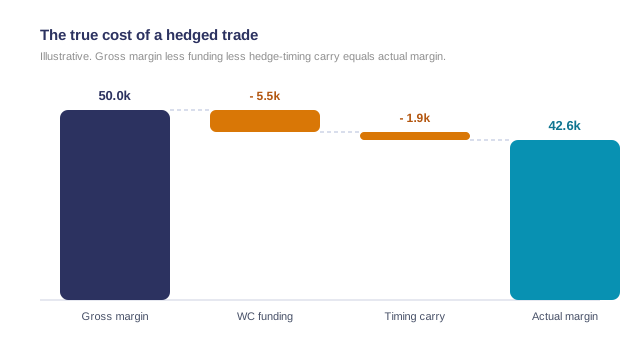
A trade's headline margin is not the margin you keep. finPhlo decomposes the realised economics into four buckets so the desk learns whether its assumptions held and prices the next deal accordingly.
Trading margin
The commercial result of the deal itself: the spread between the cost of supply and the sale, before financing and currency effects are layered in.
FX result
When a trade is fully hedged on the right tenor, the FX leg should net close to zero. A non-zero FX result usually means the hedge was mismatched, mistimed or never placed, and finPhlo shows which.
Working-capital funding
The cost of funding the gap between paying the supplier and being paid by the buyer, drawn against the facility at its all-in rate over the actual drawdown period.
Timing and carry
The cost or gain from a hedge or shipment running early or late against plan: a forward rolled, a receivable that paid behind terms, carry on stock held longer than expected.
Early, late and valued on the curve
Hedges and shipments rarely land exactly on plan. A forward that has to be rolled because the cargo shipped late, or a receivable that pays early, both change the realised cost of the currency leg. finPhlo tracks each hedge against the settlement date of its underlying trade and attributes the early or late effect to the timing-and-carry bucket, rather than letting it disappear into a single blended FX number that nobody can explain.
Open hedges are valued on the forward curve, not at spot. A forward, option or swap maturing in ninety days is marked against the relevant forward points for that tenor, so the mark-to-market on the hedge book reflects what it is actually worth to close today. For commodity-linked currencies, where rates can move materially within a session alongside the underlying commodity, valuing on the curve is the difference between an accounting figure and an economic one.
The expected margin you modelled at feasibility is the benchmark these four buckets are measured against. Where the actual margin diverges from the plan, the decomposition shows which bucket moved, so the desk prices the next deal with better assumptions.
Working-capital funding, priced honestly
Every cross-currency trade carries a financing leg as well as a currency leg: the cost of funding the period between paying the supplier and collecting from the buyer. finPhlo prices that funding at the facility's all-in rate over the real drawdown period, so the funding cost lands in the margin where it belongs rather than being assumed away.
- Funding cost tied to the actual drawdown period, not a nominal assumption.
- Cash Against Documents timelines tracked so a slow-paying buyer shows as extended exposure.
- What-if modelling of a new trade against the current portfolio before it is booked.
- Exposure, hedge coverage and tenor reporting your lender can read at a glance.
Assembled from your operations, not re-keyed
finPhlo draws trade data from opsPhlo and from other ERPs by API, bank balances and transaction feeds from your banking relationships, and commodity and FX pricing from the exchanges. Your treasury view is built automatically from your actual operations, with no second data-entry step and no reconciliation gap between the desk and the spreadsheet.
Reporting follows the same principle. When your relationship manager asks for a currency risk summary, you send a link to a live view rather than a PDF that someone assembled over two days. Banks price risk: a lender who can see that you actively manage FX exposure with a proper system prices the facility accordingly.
See your FX position as it actually is
We will run a walkthrough using your own currency pairs and trade data: your real net exposure, your hedge coverage and the four buckets behind a live trade, not what the spreadsheet thinks.